The short answer: No. A safety net isn’t required on an in-ground trampoline, and that answer surprises a lot of the families we talk to. Because the jumping surface sits level with your yard, you’ve already taken away the single biggest hazard an above-ground trampoline carries: the drop from height.
That changes the whole job of the net. It’s no longer there to stop a four-foot fall; it’s there to do something more specific. Here’s when a net genuinely earns its place, when you can skip it without losing sleep, and how to judge whether a given net is actually built well — materials, mesh, poles, and all that’s necessary.
Key takeaways
- A safety net is not legally required on a residential in-ground trampoline.
- Sitting flush with the ground removes the fall height, so the net’s real job is keeping jumpers on the mat, not preventing a long fall.
- Nets are strongly worth it for young kids, more than one jumper, and rectangular models.
- Net quality lives in the details most buyers never check: mesh opening size, UV-stabilized material, pole design, and how the net attaches to the mat.
- In Arizona, sun damage — not wear and tear — is usually what ends a net’s life.

Is a Safety Net Necessary on an In-Ground Trampoline? The Short Answer
You don’t necessarily need one, but for most backyards with kids in them, we’d tell you to get one. The in-ground design earns you a lot of safety before the net ever comes into it, so think of the net as the last layer rather than the whole safety plan.
Are Trampoline Safety Nets Required by Law or Guidelines?
There’s no federal or Arizona law that makes you put a net on a backyard trampoline. However, it’s always worth it to keep some points in consideration before guessing anything regarding an in-ground trampoline.
The U.S. Consumer Product Safety Commission recommends safety padding, one jumper at a time, and adult supervision.
The American Academy of Pediatrics takes a firmer line — it discourages recreational trampoline use for children altogether, and where families choose to have one, it calls for constant supervision and safety measures like enclosures.
On the manufacturing side, quality nets are built to a voluntary industry standard, ASTM F2225, which sets safety requirements for consumer trampoline enclosures. None of that is a mandate. All of it points the same direction.
When a Safety Net Is Strongly Recommended
Add the net if any of these describe your yard:
- Young children will be jumping, or kids will use it without an adult right there.
- More than one person tends to be on the mat at once.
- You have a rectangular model, where jumpers can travel toward the edge with real speed.
- There’s hardscape nearby — pavers, a retaining wall, decorative gravel, a pool deck.
When You Might Reasonably Skip the Net
We’d rather be straight with you than sell you netting you don’t need. You can reasonably go without if the trampoline is used by adults only, if it’s set up for gymnastics training where a net gets in the way, or if it’s a smaller round model ringed by grass or soft landscaping.
Being honest about this is the whole point — a net solves some problems and does nothing for others, and you deserve to know which is which before you spend the money.
How a Safety Net Works on an In-Ground Trampoline
Why In-Ground Trampolines Already Reduce the Risk
The reason in-ground units are safer starts with something simple: the mat is level with the ground, so there’s no height to fall from. A jumper who comes down near the edge steps off onto the lawn, not off a raised frame. That ground-level design is the genuine safety advantage here, and it’s doing most of the work before you add anything.
What a Net Prevents That Ground Level Doesn’t
So what’s left for the net to handle? Plenty, actually. Even with no fall height, a jumper can still come down awkwardly on an elbow, a shoulder, or a knee at the edge of the mat, and a net keeps them centered where the bounce is safest.
It also keeps kids from bouncing off onto whatever surrounds the trampoline. Landing on grass is one thing; landing on pavers or gravel is another.
How In-Ground Nets Differ From Above-Ground Nets
Here’s a mistake we see all the time: someone tries to reuse or buy an above-ground net for an in-ground trampoline, and it doesn’t fit. In-ground nets use shorter poles and mount to the frame or the surrounding retaining wall rather than to a set of legs.
On better enclosures the netting sits just inside the edge of the mat, so a jumper never touches the frame at all. If you’re shopping, match the net to the in-ground unit specifically — an above-ground enclosure usually won’t work.
Are In-Ground Trampolines Safer With or Without a Net?
Short answer: a net makes an already-safe setup safer, but it’s honest to say what it can and can’t do.
| Consideration | With a safety net | Without a net |
|---|---|---|
| Falling off the mat onto hardscape or gravel | Prevented | Possible |
| Keeping young or multiple jumpers in the safe zone | Yes | No |
| Injuries from collisions or failed flips on the mat | Not addressed | Not addressed |
| Backyard sightlines and looks | Poles and netting are visible | Cleanest look |
| Best suited to | Kids, families, rectangular models, hardscaped yards | Adult-only, gymnastics, soft-landscaped round models |
What a Net Actually Prevents
The net’s strength is boundaries. It keeps jumpers over the mat and off the ground around it, which matters most for little kids who don’t track where the edge is yet.
What a Net Can’t Fix
This is the part most sellers skip. A large share of trampoline injuries happen on the mat, not off it — two kids colliding, or one landing a flip wrong. A net does nothing for those. That’s why we tell every family the same thing: the net helps, but the one-jumper rule and an adult watching do more.
What the Research Says
Both the CPSC and the AAP have looked hard at trampoline injuries, and the recurring themes are consistent: supervision, one jumper at a time, and enclosures reduce risk, while multiple jumpers drive a lot of the injuries.
The Anatomy of an In-Ground Trampoline Enclosure
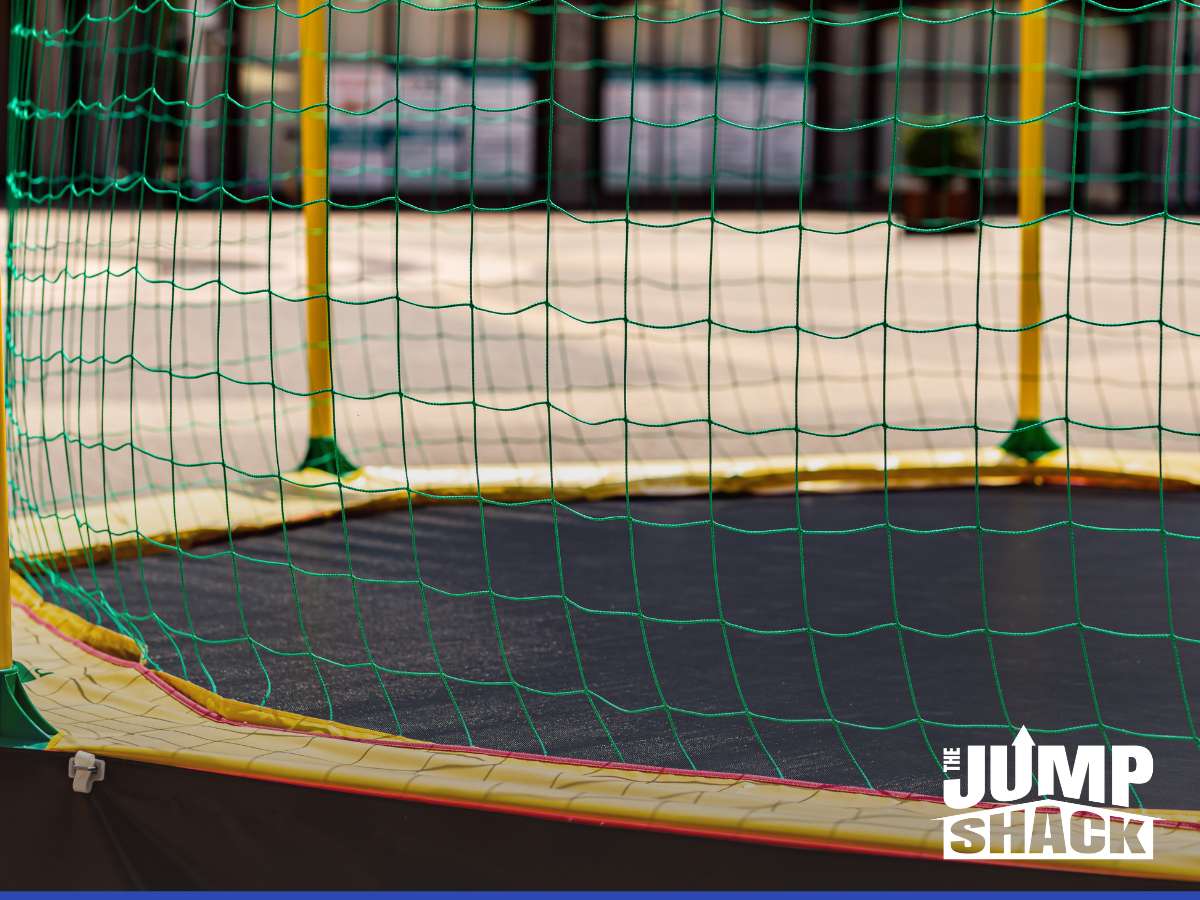
If you want to judge a net properly, it helps to know what you’re actually looking at. A trampoline enclosure is a small system of parts, and a weakness in any one of them is where an accident starts.
- The netting is the visible barrier. What matters is the material it’s knit from and the size of its openings (more on both below).
- The poles hold the net upright. Their number, spacing, and stiffness decide whether the net stays taut or sags into the jumping zone.
- The foam pole sleeves pad every upright so a jumper who bumps a pole hits foam, not steel.
- The top ring or rail — on many designs a band running around the top of the poles — keeps the net’s mouth open and evenly tensioned instead of collapsing inward.
- The attachment system ties the bottom of the net to the mat or frame. This is the part almost nobody inspects and the part that fails most consequentially.
- The entry is the door you climb through, and a good one closes two ways so it can’t drift open mid-bounce.
The rest of this guide will explain how to separate a net you can trust from one that just looks the part.
What to Look for in an In-Ground Trampoline Safety Net
Mesh Material: PE, PP, and PVC-Coated Polyester
Trampoline netting is usually made of materials like polyethylene (PE) and polypropylene (PP), which are knit into a mesh, and on heavier-duty enclosures, PVC-coated polyester.
Each material behaves differently. PE is soft, flexible, and holds up well to sun once it’s UV-stabilized. PP is lighter and often used in knitted nets, but it needs proper UV treatment or it gets brittle fast. PVC-coated polyester is the most weatherproof and abrasion-resistant of the three, at more weight and cost. There’s also a construction difference worth knowing: knotless (Raschel-knit) netting is softer and less abrasive on skin than older knotted netting, and it tends to distribute impact more evenly.
Mesh Opening Size
The size of the holes is a safety spec, not a detail. Openings need to be small enough that a small child’s fingers, toes, or head can’t push through or get caught, which is exactly the kind of entrapment ASTM F2225 is written to prevent. As a rule, you want a tight weave rather than a wide one.
UV Resistance — Why It Matters More Here Than Almost Anywhere
This is the feature that decides how many seasons a net can last in Arizona. Polyethylene and polypropylene break down under sunlight through photo-oxidation — ultraviolet light attacks the polymer chains and the material slowly loses its strength and stretch.
Manufacturers slow this down by building UV stabilizers into the resin (carbon black and hindered-amine light stabilizers are the usual ones), which is why a “UV-rated” net and a bargain net can look identical on day one and be worlds apart by year three. You can read the failure before it happens: fading color, a chalky residue on your hand when you rub the mesh, stiffness where the netting used to flex, and threads that tear with little effort.
Poles, Foam Sleeves, and Net Height
Poles do more than hold the net up. Their count and spacing determine how tight the barrier stays: too few, and the net bows inward between them where a jumper can push it. Look for galvanized or heavy-gauge steel that holds its shape, or the arched fiberglass rods some systems use to pull the net away from the jumping surface.
Every pole should be wrapped in thick, UV-resistant foam that covers it end to end — the best layouts put the poles outside the netting so a jumper’s momentum meets net first, foam second, and never bare metal. Height matters too: the enclosure has to be tall enough to contain a jumper at the top of a hard bounce, not just at standing height.
The Net-to-Mat Connection — The Part That Actually Fails
Here’s the detail that separates a real safety enclosure from a decorative one: how the bottom of the net meets the mat. On a well-built system the net attaches at the jumping surface itself — often with buttonhole straps or a rod threaded through the mat’s edge — so there is no gap between net and mat. A gap there is a genuine hazard: small feet and legs slip into it, and it’s a documented way kids get hurt or squeezed out entirely.
Frame Padding Still Counts
Even at ground level, there’s a frame and springs (or, on some models, rods) around the edge of the mat, and the pad over them is part of the safety picture. The net keeps jumpers off the surroundings; the edge padding keeps them off the hard parts of the trampoline itself. Treat them as a pair, and don’t let a worn pad slide just because the net looks fine.
Warranty and Replacement Coverage
Check what’s actually covered and for how long. At The Jump Shack, we always inform our clients about our warranties so they can have peace of mind when buying in-ground trampolines and their accessories.
What Size Safety Net Does Your In-Ground Trampoline Need?
Fit is not a place to improvise. A net that’s close but not exact leaves gaps, won’t tension, or won’t mount to the frame. The right size is driven by two things: the trampoline’s outer dimensions and its shape.
Round In-Ground Trampolines
Round models are the more forgiving of the two, because the bounce naturally pulls jumpers back toward the middle. Size the net to the exact diameter and match the pole count to the frame’s mounting points.
Rectangular In-Ground Trampolines
Rectangles give a higher, more directional bounce, which is why athletes like them and exactly why the net has to be right for the length. A jumper can travel toward an end with real speed, so pole spacing and net tension along the long sides matter more here than on a round.
Why Your Net Should Match Your Trampoline Brand
Buy the net made for your trampoline where you can. It’s not upselling; it’s fit, mounting compatibility, and warranty. A net built for your frame lands on the exact attachment points and won’t void coverage the way a mismatched part can.
How Arizona Heat and Monsoon Season Affect a Trampoline Net
A trampoline in Gilbert lives a harder life than the same trampoline in a mild climate, and two local forces do most of the damage.
The first is heat and sun. Beyond the UV breakdown of the netting itself, a dark mat sitting in full summer sun gets hot enough to burn bare feet, so it’s worth checking the surface with your hand before kids climb on and steering jumping toward the cooler morning and evening hours. Keep water nearby; kids don’t notice dehydration on a trampoline until it’s a problem.
The second is monsoon wind. An enclosure is essentially a sail on poles. When a haboob or a summer storm is in the forecast, the safe move is to take the net down or make sure the poles and frame are properly secured, because sustained gusts can bend poles and stress every attachment point at once.
How to Inspect and Maintain Your Safety Net
A net is a wear part, and a five-minute check every few weeks catches the problems that matter. Here’s the routine we give our customers:
- Attachment points. Tug the bottom edge and the strap or rod connections. Nothing should lift away from the mat.
- Seams and stitching. Run your eye along the seams for fraying or pulled threads; seams fail before the field of the net does.
- The entry closure. Zip and unzip it, and check that the secondary clips or buckles hold. A door that creeps open is a door that isn’t there.
- Pole foam. Make sure every sleeve is intact and still covers the full pole. Cracked or missing foam means exposed steel.
- A quick strength test. Rub the mesh and give it a firm pull. Chalky residue, stiffness, or threads that give easily mean UV has won and it’s time to replace.
- Tension. A saggy net lets kids reach the poles and opens gaps. Re-tension it or replace worn elastic.
When you clean it, use mild soap and water only. Bleach and solvents accelerate exactly the kind of chemical breakdown you’re trying to slow down. And replace a net at the first real sign of UV failure rather than after it tears.
In-Ground Trampoline Safety Rules That Matter as Much as the Net
A net is just one layer. The following habits do at least as much to keep kids safe.
Supervision and One Jumper at a Time
The single most effective rule is also the least popular with kids: one jumper on the mat at a time, with an adult watching. Most collision injuries disappear the moment you enforce it.
Age and Ability
Only children who can walk steadily on their own should be on a trampoline, and the AAP’s guidance is worth reading before you decide the right age for your family.
Set It Up in the Right Spot
Give the trampoline clear space overhead and around it — clear of overhanging branches and with room on all sides. The net handles the edges; open clearance handles everything the net can’t.
In-Ground Trampoline Safety Net Questions, Answered
Do in-ground trampolines need a safety net?
Not by law, but it’s strongly recommended for most families — especially with young kids, multiple jumpers, or a rectangular model.
Can you add a safety net to an existing in-ground trampoline?
Yes. You can retrofit a net to a trampoline that was installed without one, as long as you match the enclosure to the model.
Will an above-ground trampoline net fit an in-ground trampoline?
Usually not. In-ground nets use shorter poles and mount differently, so an above-ground enclosure typically won’t fit correctly. Buy the net made for the in-ground unit.
What is the safest safety net design?
The safest enclosures share a few traits: UV-stabilized knotless netting with small openings, poles padded and set outside the net, and a bottom edge that attaches directly to the mat with no gap. That last one matters most.
Find the Right Safety Net for Your In-Ground Trampoline
So, is a net necessary? Not strictly — but for most families it’s the right call, and the honest answer to “which one” comes down to the details we’ve walked through: the right material, a tight mesh, padded poles, and a gap-free connection to the mat, sized to your exact trampoline.
That’s the part people get wrong, and it’s a five-minute conversation to get right the first time. If you need more help with your safety net or in-ground trampoline, feel free to call us at (800) 414-2001 or contact us through our website. At The Jump Shack, we install and service in-ground trampolines across Phoenix, Mesa, Gilbert, and throughout Arizona.

The Jump Shack
1528 W San Pedro St #4
Gilbert, AZ 85233
Tel: (800) 414-2001
Email: [email protected]
Website: aztrampoline.com